

Our van slid out of Siem Reap, the asphalt gave up, and the air got dense like someone turned the humidity knob without asking. At the lake edge the first thing you notice isn’t the view. It’s the smell: freshwater funk, churned silt, warm plant rot. Then the noise—longtail engines chewing water, not purring. And then the hit of scale: stilts rising out of mud and glare, lifting entire blocks into the sky like the ground just stopped being a reliable idea.
This is a field-backed, no-fluff guide to choosing a floating-village experience near Siem Reap—without walking straight into the “closest village” tourist factory routine that makes thoughtful travelers feel gross. We focused on two places that behave nothing alike: Kampong Phluk (stilt life plus the flooded-forest detour when the water cooperates) and Kampong Khleang (a longer, more logistics-heavy run that leans into remoteness). The goal here is simple: match the village to your tolerance for travel time, crowds, and seasonal reality… because Tonlé Sap doesn’t care what a brochure promised.
🧭 Pick Your Village
- If you want the classic kampong phluk sunset tour vibe and strong visuals in a short window, Kampong Phluk wins.
- If you want a longer, more remote-feeling day and can handle extra road time, Kampong Khleang is the play.
- Water level changes everything. Don’t book a fantasy; book a season.
- Expect optional add-ons (like the flooded forest canoe) to be priced separately on some itineraries.
Floating Villages at a Glance
- Best time to visit: For maximum “floating” visuals, aim for monsoon/high-water months (roughly May–Oct, strongest later in the wet season). For maximum “stilt” visuals, aim for the dry season (roughly Nov–Apr).
- Average price range: Budget shared group tours: ~US$20–$35 per person. Mid-range small group tours: ~US$40–$60 per person. Private/luxury tours: ~US$100+ and can reach ~US$179–$200+ per group depending on exclusivity and add-ons.
- Key architectural styles: Stilt houses (especially Kampong Phluk) and seasonally shifting “floating” visuals driven by water level changes.
- Typical starting point: Siem Reap.
The Ecosystem & The Truth
Tonlé Sap isn’t a lake you “visit.” It’s a seasonal system that rewrites the map. When the monsoon pushes the Mekong up, the Tonlé Sap River reverses and shoves water back into the lake, swelling it across the floodplain. That reversal is the micro-history in two sentences, and it explains the rest: why boats become streets for months, why fish cycles matter more than your schedule, why houses climb onto stilts because the waterline will show up like an uninvited relative and stay. In wet months the village sits inside reflections; in the dry season the water pulls back and the engineering becomes the headline—posts, stairs, and the uncomfortable truth that “shoreline” is a temporary concept.

🚨 Myth Check
A common misconception about visiting Tonle Sap is that the houses are always floating. The truth: a lot of what people call “floating villages” near Siem Reap are stilt villages, and the “floating” look is often the wet-season illusion when water buries the legs. Another mistake travelers make is assuming the dry season means “no water.” There is water. What changes is access, distance to open lake, and the visual drama. You’re not booking a static attraction; you’re booking a season.
Data Overview: Comparing the Top Options
| Tour Style | Best For (Traveler Profile) | Primary Village / Focus |
|---|---|---|
| Kampong Phluk Sunset Boat Experience (5h) | Sunset chasers and photo-first travelers who want golden-hour light and a time-boxed plan | Kampong Phluk stilt zone + sunset waterline (optional flooded-forest canoe as add-on) |
| Kampong Phluk Stilt Village + Tonlé Sap Cruise (6h, shared small-group) | First-timers who want the classic “Phluk in a half-day-ish” structure with predictable pacing | Kampong Phluk stilt village + open-lake cruise |
| Private Kampong Phluk: Market + Pagoda + Flooded Forest Canoe (half-day private) | Couples/families who want calm pacing and modular cultural stops | Kampong Phluk + flooded forest canoe loop |
| Kampong Khleang Remote Village + Kleang River Private Craft (6.5h) | Travelers seeking a longer, more “river journey” feel and a remote-village framing | Kampong Khleang via Kleang River craft; water-level dependent routing |
| Tonlé Sap Lake & Kampong Khleang Village Day Tour (5–6h private/day format) | Travelers who want a Khleang-branded day format with structured timing and fewer moving parts | Kampong Khleang + lake-edge viewing; water-level dependent visuals |
In-Depth Analysis: The Standout Experience
Kampong Phluk Sunset Boat Experience (5h)
Ideal for: travelers who want the lake at its most photogenic and least punishing. Skip this if: you can’t stand popular time slots and get irritated when a “quiet place” feels like a shared secret.
I picked this as the top performer because it respects how Tonlé Sap actually behaves. Sunset timing isn’t just aesthetic; it fixes two problems at once: harsh midday glare, and that frantic “are we done yet?” feeling you get when a tour tries to squeeze a village and a lake into a tight block. The late-day run feels intentional. You move from Siem Reap’s dust to the lake’s sheen, and the transition reads like a story, not a commute.

When our boat eased into the village-water edge, the sensory stack did the work. The air carried damp greenery and engine exhaust. The driver opened the throttle, then backed off, letting the hull slide instead of slap. You see stilt houses in phases: silhouette first, then structure—posts, platforms, stairs—then the human layer, the porches, the small routines that make “kampong phluk tour” sound like a lazy headline. In high water, the line between house and lake blurs; in low water, the stilts become the whole point. It’s not a trick. It’s design.
Our guide didn’t romanticize it. Good sign. He watched the light, then said something that felt more useful than any speech about “local culture.”
“The lake runs the calendar. When it rises, the village learns to move. When it falls, we climb and wait.” — Local guide on Tonlé Sap
🛶 Price Reality (Before You Board)
One practical detail good operators state plainly: the flooded forest canoe loop is often priced as a separate add-on fee. If you arrive assuming it’s bundled, you’ll feel like you’re being worked. If you arrive expecting the choice, you’ll treat it like a decision—pay it, or skip it, without drama.
Comprehensive Reviews: Other High-Performing Itineraries
1. Kampong Phluk Stilt Village + Tonlé Sap Cruise (6h, shared small-group)
Ideal for: first-timers who want a clean, predictable Kampong Phluk floating village run with a social group rhythm. Skip this if: curated stops and production-line pacing make you itchy.
This is the classic template: pickup, drive, covered boat, stilt zones, open lake, back to Siem Reap. Efficient. Legible. It feels engineered for people who want to know what they’re getting. I don’t hate that. Most travelers aren’t trying to roleplay as anthropologists; they just want the Kampong Phluk tour to make sense.
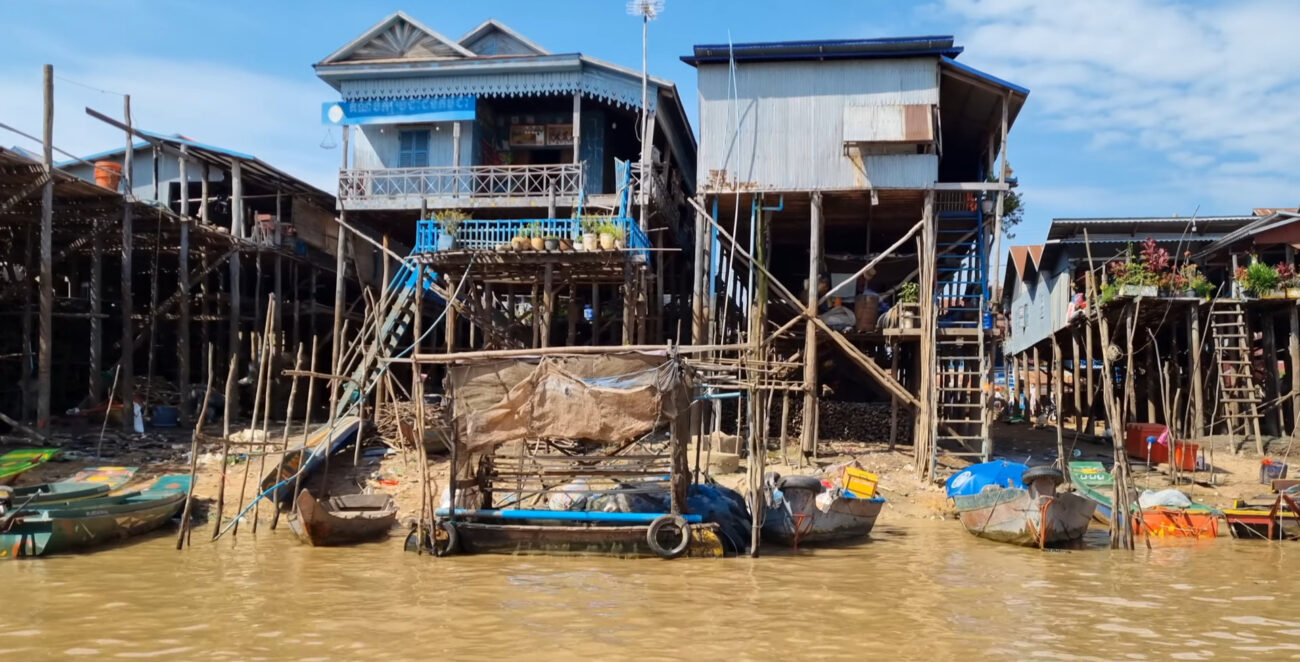
The surprise is how fast your brain normalizes the spectacle. The first minute is cinematic. Then you start noticing geometry and habit: the angle of stairs, the way platforms are built for changing water marks, the practical logic behind those tall posts. The tour moves at a steady clip and it doesn’t apologize for it. If you want long conversations, you’ll feel boxed in. If you want a coherent overview you can file in your head, it works.
- High review volume and strong aggregate rating on the listing (a proxy for consistent operational delivery).
- Clear half-day-ish timing that works around other major Siem Reap activities.
- Pickup is typically offered, reducing DIY friction.
- Add-ons (such as the flooded-forest canoe loop) may be extra depending on season and operator.
- “Floating” visuals vary strongly by water level and season; the look is not guaranteed.
2. Private Kampong Phluk: Market + Pagoda + Flooded Forest Canoe (half-day private)
Ideal for: couples and families who want control over pacing and fewer crowd variables. Skip this if: you’d rather save money and don’t care about tailoring the day.
Private pacing changes the whole ethical temperature. You stop acting like a consumer on a conveyor belt and start behaving like a guest. The land-side pieces—market and Buddhist pagoda—do something subtle: they stitch Kampong Phluk back into Cambodia instead of treating it as a floating stage set. Markets smell like fish sauce and fruit skins, and they’re messy in a way that reads as real life, not tourism.

Then you hit the canoe loop through the flooded forest. When conditions line up, it’s quiet—quiet in a way Tonlé Sap usually isn’t. Paddles whisper, trees trap the sound, and your brain slows down. It’s also the moment where etiquette matters more than your camera settings. Ask before you shoot. Don’t angle for “poverty content.”
- Includes culturally grounded stops (market and Buddhist pagoda) that provide context beyond the boat ride.
- The flooded-forest canoe loop is explicitly featured as a core visual and experiential highlight.
- Private pacing reduces the “assembly line” feeling and allows more controlled observation.
- The canoe element may be treated as a separate fee in some operator variants; do not assume it is included.
- Water levels can materially change what you see (stilts emphasized in dry season, “floating” illusion stronger in wet season).
3. Kampong Khleang Remote Village + Kleang River Private Craft (6.5h)
Ideal for: travelers who want a longer day, a river approach, and a remote-village framing that feels less staged. Skip this if: long transfers make you cranky and you want maximum “wow” per minute.
Khleang is a different animal. The road time is longer—often around 1.5 hours each way from Siem Reap—and that changes your headspace. You don’t pop out for a quick look and bounce. You commit. And when you commit, you tend to pay attention to the boring details that make a place real.
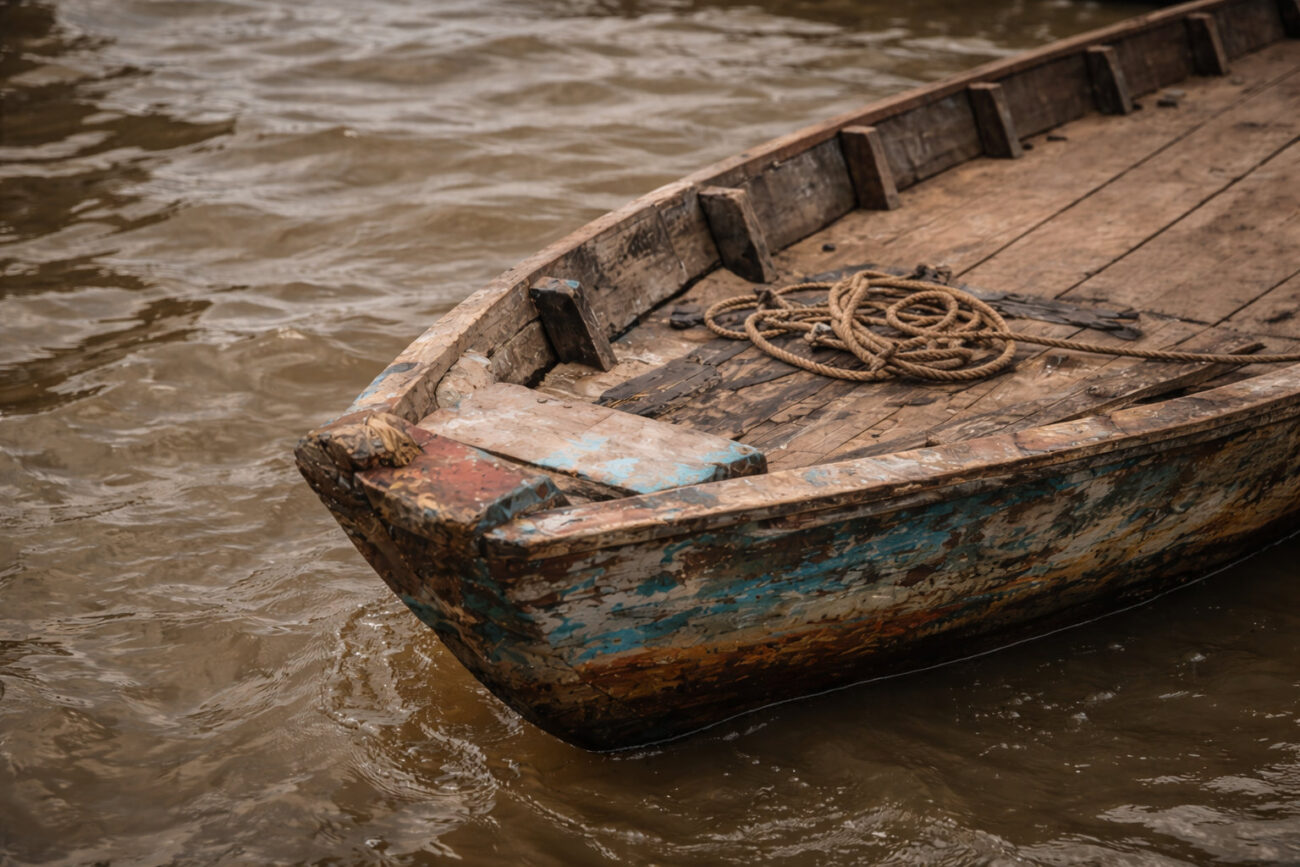
The river craft approach matters. It shifts the experience from “floating village” to “working landscape,” and you feel that shift in small ways: the rhythm of the ride, the sense of entering rather than arriving. Water-level dependence is flagged openly, which I like. It also means the route can change. If you need a rigid checklist, you’ll be annoyed.
- Remote village framing and a longer journey that feels less “near-city circuit.”
- Private river craft is a differentiator versus standard shared boat transfers.
- Operators often flag water-level dependency up front, setting expectations honestly.
- Water-level dependence can change route, access, and the look of the experience.
- Longer travel time makes this a logistics-forward day compared to Kampong Phluk.
4. Tonlé Sap Lake & Kampong Khleang Village Day Tour (5–6h private/day format)
Ideal for: travelers who want Kampong Khleang by name in a structured, time-contained plan. Skip this if: you’re sensitive to bumpy approaches and hate rural dust.
This is the cleaner architecture version of Khleang: a defined duration window, fewer moving parts, straightforward sightseeing. For some travelers that structure is the whole point. You don’t want surprises. You want a plan that behaves.

On the water, the same truth shows up again: the lake controls the visuals. In high water, the interface between village and lake can feel seamless; in low water, the village stands higher and the lake sits farther out. If you want the word “floating” to feel literal, time it with monsoon. If you want the stilts to dominate the frame, the dry months give you that harsh clarity.
- Clear 5–6 hour duration window helps with itinerary planning.
- Often sits within the private/day tour band for travelers who want fewer crowd variables.
- Good fit if you want Kampong Khleang specifically rather than a closer “floating village circuit.”
- Pricing is materially higher than budget shared tours.
- Water levels can change access, route, and the “floating” look.
5. Kampong Khleang Half-Day Tour (compressed-format)
Ideal for: travelers who want a quick Kampong Khleang sample and don’t mind compression. Skip this if: you want depth and hate a long transfer-to-water ratio.
This format exists because people ask for it, constantly: “Can I do Khleang without giving up the day?” Yes. But you pay in time math. The drive still takes time, so the on-water window can feel tight, and tight windows make places feel like backdrops.
If you treat it as reconnaissance—closer to an introduction than a deep encounter—it does its job. If you want immersion, it can leave you frustrated right as your curiosity finally wakes up.
- Provides a Kampong Khleang option without committing to a longer, expedition-like day format.
- Works as a “taste” of a more remote village framing for travelers with limited time.
- Often positioned as cultural exposure beyond the closest villages near Siem Reap.
- Lower certainty versus high-volume products if review depth is limited on a given operator variant.
- Long transfer-to-experience ratio is inherent for Kampong Khleang.
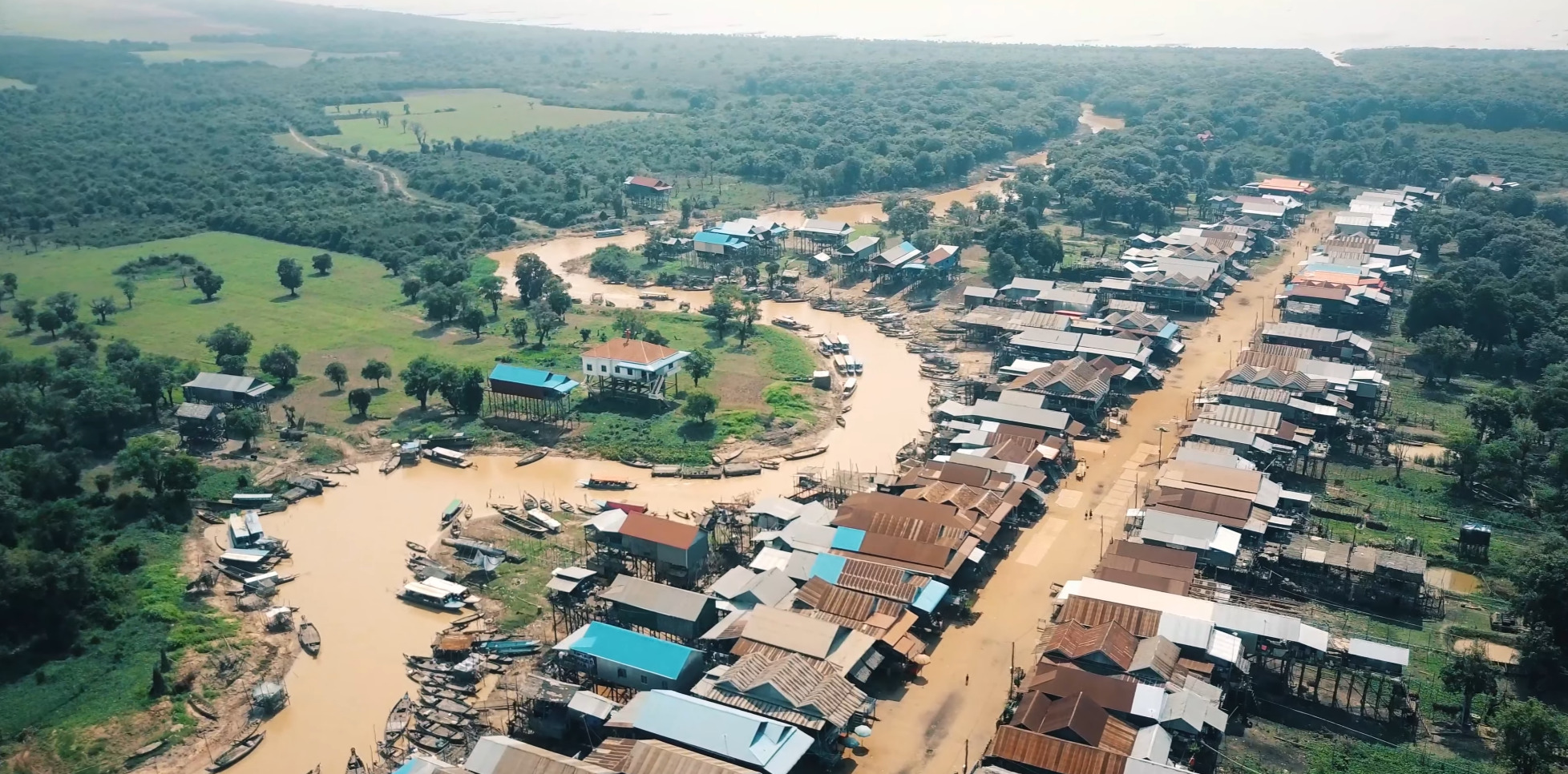
Drone photography during the dry season


Expert Field Notes
🛶 Insider Tip: The Canoe Fee Changes the Mood
The flooded-forest canoe loop at Kampong Phluk is often a separate, per-person add-on fee (commonly around US$5). Small money, big mood swing. If you’re surprised at the dock, it feels like a trust tax. If you arrive expecting the choice, you stay relaxed and you can actually enjoy the water.
- Expect a separate payment moment for the canoe loop on some itineraries.
- Pack small bills so you’re not stuck negotiating change at the water’s edge.
- Plan for basic toilet realities on the lake: assume minimal facilities and carry tissues/sanitizer.
- Practice photo etiquette: ask before photographing people, and avoid framing children as props.
⚠️ Reality Check: Add-Ons & “All-In” Assumptions
Independent fee breakdowns around Tonlé Sap commonly describe a base village/boat ticket plus separate pricing for the flooded-forest canoe. Don’t assume one payment covers every water segment. Ask what’s included before you step onto the dock and get emotionally cornered.
Frequently Asked Questions
Is Kampong Phluk actually a floating village year-round?
No. Kampong Phluk is widely characterized by stilt-house architecture. In wet season, rising water can cover stilts and create a floating illusion; in dry season, the stilts are visually obvious and the “floating” look is reduced.
How far is Kampong Phluk from Siem Reap in realistic driving time?
Common estimates show roughly 30 km and about 45 minutes by road, varying by pickup point and traffic.
How far is Kampong Khleang from Siem Reap in realistic driving time?
Commonly cited around 50 km and often about 1.5 hours each way, with variability due to stops, rain, seasonal conditions, and water levels.
What’s Next?
Tonlé Sap rewards travelers who pick a style honestly. Do you want the sunset-timed Kampong Phluk tour with that classic kampong phluk floating village light, plus the flooded forest option when water levels allow—or do you want the longer Kampong Khleang run where the river approach makes the day feel earned? If you’re the kind of traveler who keeps chasing water-shaped cultures across Southeast Asia, you already know what to read next: more communities built around seasonal logic, not tourist logic.